
Mining Overview
Mining is the process of securing the Cloud Service network and earning CS rewards by contributing computational power. This guide covers everything you need to know about mining Cloud Service.
How Mining Works
Cloud Service uses ZelHash (Modified Equihash 125,4), an ASIC-resistant mining algorithm designed to be GPU-friendly and promote decentralized mining.
Mining Process
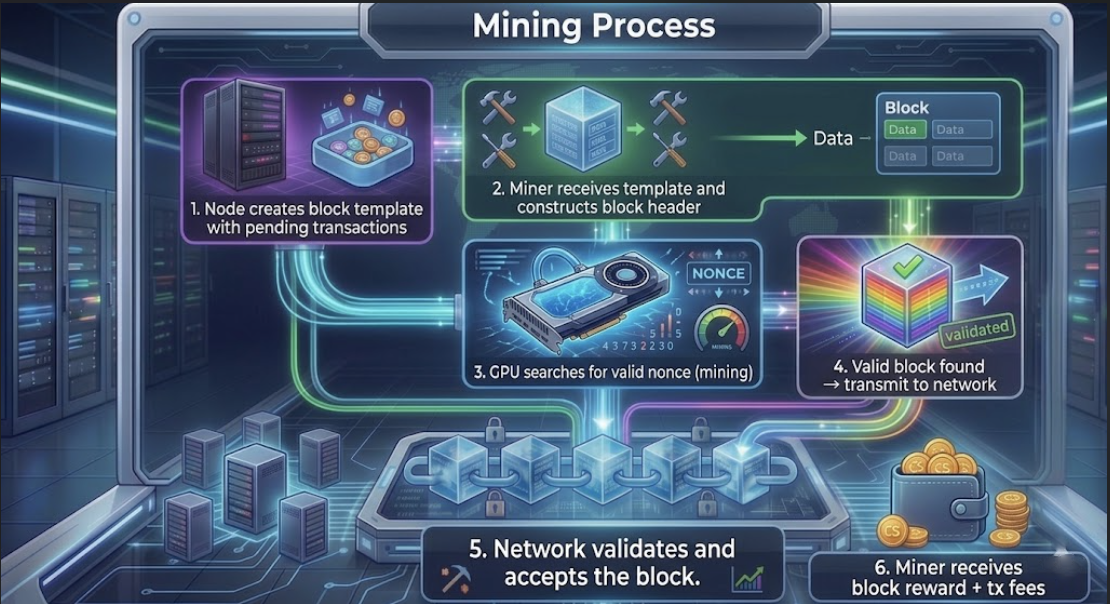
ZelHash Algorithm
Why ZelHash?
| Feature | Benefit |
|---|---|
| ASIC-Resistant | Memory-hard computation prevents ASIC dominance |
| GPU-Friendly | Runs efficiently on consumer GPUs |
| Equihash-Based | Proven security model |
| Fair Distribution | Anyone with a GPU (≥1.3 GB VRAM) can mine |
Algorithm Details
| Parameter | Value |
|---|---|
| Algorithm | ZelHash (Equihash 125,4) |
| Hash Function | Blake2b + "ZelProof" personalization |
| Equihash Parameters | n=125, k=4 |
| Memory Required | ~1.3 GB VRAM |
| Difficulty Adjustment | LWMA3 (every block) |
Mining Rewards
Block Reward Schedule
| Period | Block Reward | Blocks | Annual Emission |
|---|---|---|---|
| Ramp-up (~28 days) | 0 → 150 CS | 20,000 | ~1,500,000 CS total |
| Era 1 (~2.5 years) | 150 CS | 645,350 | ~39,420,000 CS/year |
| Era 2 (~2.5 years) | 75 CS | 655,350 | ~19,710,000 CS/year |
| Era 3+ (permanent) | 37.5 CS | ∞ | ~9,855,000 CS/year |
Reward Components
- Block Reward — Fixed CS per block
- Transaction Fees — All fees from included transactions
- No Developer Tax — 100% goes to miners
Mining Options
Solo Mining
Mine independently and receive full block rewards when you find a block.
Pros:
- Full reward when you find a block
- No pool fees
- Maximum decentralization
Cons:
- Irregular income
- Requires significant hash power
- Higher variance
Pool Mining
Join a mining pool to receive regular, proportional rewards.
Pros:
- Consistent income
- Lower variance
- Accessible to small miners
Cons:
- Pool fees (1-3%)
- Less decentralization
- Trust in pool operator
Cloud Mining
Rent hash power from cloud mining providers.
Pros:
- No hardware required
- Easy to start
- No electricity costs
Cons:
- Lower profitability
- Trust in provider
- Potential scams
Getting Started
Requirements
- GPU — AMD or NVIDIA with 4+ GB VRAM
- Wallet — Cloud Service wallet for receiving rewards
- Mining Software — Compatible miner (see below)
- Pool Account (optional) — For pool mining
Compatible Mining Software
| Software | GPU | OS | Notes |
|---|---|---|---|
| GMiner | AMD/NVIDIA | Linux/Windows | Recommended |
| T-Rex | NVIDIA | Linux/Windows | NVIDIA optimized |
| TeamRedMiner | AMD | Linux/Windows | AMD optimized |
| NBMiner | AMD/NVIDIA | Linux/Windows | Good performance |
| lolMiner | AMD | Linux/Windows | AMD focused |
Profitability Factors
Key Variables
- Hash Rate — Your GPU's mining speed (Sol/s)
- Power Consumption — Electricity usage (Watts)
- Electricity Cost — Price per kWh
- CS Price — Market price of CS
- Network Difficulty — Current mining difficulty
Estimated Profitability
Daily Revenue = (Your Hash Rate / Network Hash Rate) × Blocks per Day × Block Reward

Daily Cost = (Power Consumption × 24 / 1000) × Electricity Cost per kWh

Daily Profit = Daily Revenue × CS Price - Daily Cost
Next Steps
- Getting Started with Mining — Step-by-step setup
- Mining Pools — Available pools
- Troubleshooting — Common issues